Everyone has their own signs that autumn has arrived. For some it’s a pumpkin spice latte, a change in foliage, or the first cool crisp air of the season. Here in Houston, though, where it’s still late summer by those measures, I have a different tell-tale sign that fall has arrived.
It’s the first email from a stranger at another university asking if I plan to update my Generic Syllabus Maker to work for the next calendar year.
This year, that email came this week, and I was happy to oblige by updating the tool, which has now been around for more than a decade. In fact, according to my records, in just eleven days the original Syllabus Maker will be turning exactly eleven years old. And that sends me on a trip down memory lane.
In the fall of 2015, when I made the Syllabus Maker, I was still learning to code seriously with Python for the first time, which meant I was also diving even deeper into command-line tools. I was working as an editor for the Programming Historian, where the previous year I had helped with the migration of the site to GitHub Pages using Unix tools, Python, and Pandoc. I was newly entranced (and still am) by the simplicity and beauty of the Unix philosophy: the aspiration to write and use software tools that did “one thing well.”
At Rice, I was also beginning a term as magister of Duncan College, one of the university’s residential colleges. It’s a role in which faculty members serve as mentors for students and are charged with creating opportunities for intellectual enrichment within residential life.
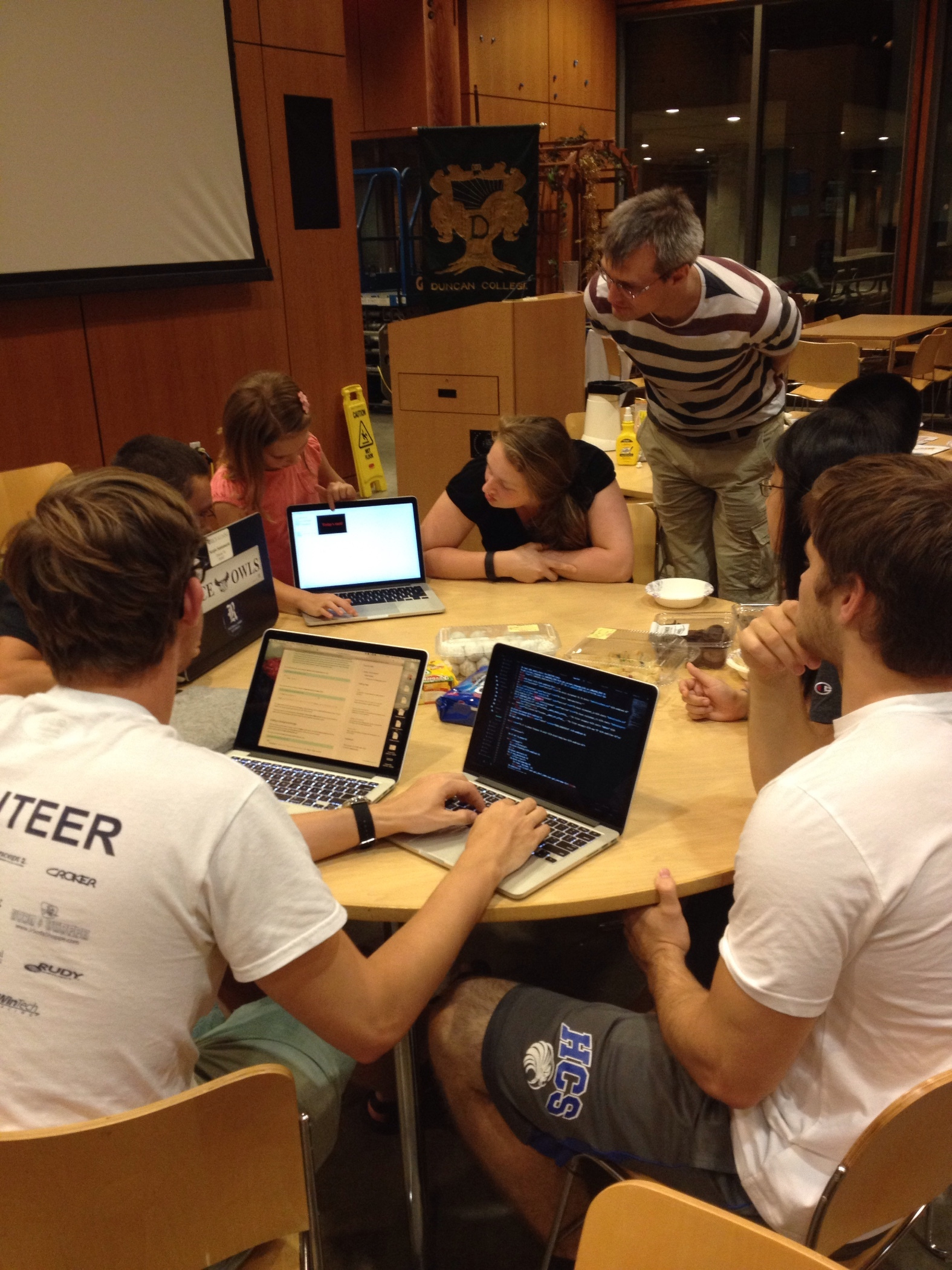
One early idea I had was to host a “hackathon” for students at Duncan and Baker College (our sister college). Together with student leaders and my colleague in physics Stephen Bradshaw (who was then a resident associate at Baker), we organized a weekend event in October 2015 and offered prizes to students who could develop a program or tool that would help out at the residential colleges. In the meantime, Stephen and I would brainstorm and try to stand up tools that could help Rice faculty members with their work.
And that’s how the Syllabus Maker was born, with the goal of coding a simple program in a weekend that would do one thing well. Namely, given the days of the week when a class met, it would generate a list of all the dates on which a class would meet in a given semester.
I have very fond memories of that initial “BaDunc” hackathon. One student I remember using the time to hack around on a sports analytics tool; he’s done very well for himself since.
I also get a little emotional thinking about how the students and Stephen welcomed my daughter, then in elementary school, as she shared her first coding experiments with Scratch. She’s done very well since, too, and I’m grateful for all those good people in the photograph at the end of this post who encouraged her passions along the way.
By the end of the hackathon, the Syllabus Maker was live and ready for use by Rice University professors. But I think it was a couple more years before I added a generic version that could be used by faculty anywhere. Not long after, the site was featured in ProfHacker, a blog at the Chronicle of Higher Education.
And that’s when the Syllabus Maker became, if not viral, something bigger than I had ever anticipated.
Over the ensuing years, about twice a year, I began receiving numerous heartfelt thanks and testimonials on Twitter, including from academic celebrities I had never met. It became a kind of ritual, some told me, to start the semester by firing up the Syllabus Maker and getting a list of dates.
Since I exited Twitter a while ago, the shout-outs don’t always reach me anymore, but apparently they continue on other platforms. A few weeks ago, while at the gym, I ran into a colleague here at Rice who had learned about the site from a friend on Instagram, only to discover that it was born here in Houston.
Clearly, I had not been the only faculty member who dreaded the tedious (and error-prone) task of updating syllabi with a semester’s new days. Still, the outpouring of gratitude and glee took me (and still takes me) a bit by surprise. To me, the “killer app” was the Rice-specific one, because it could scrape the registrar’s webpage for the academic calendar and show not only the days when a class would meet, but when it would not meet due to university holidays. The generic version can’t do that.
It’s also somewhat surprising to me—but refreshing, too—that the site remains in use even in the age of chatbot makers, whose philosophy (contra the founders of Unix) seems to be to make programs that do “all things half-well.” Last year, as an experiment, I got Gemini to generate a generic list of classes for me. Presumably other faculty members could do the same, replacing their ritual with an even more abstracted automation. Even so, many still come to the Syllabus Maker.
I’m glad that they do. For one thing, at least when I experimented with it, Gemini took much longer to think about and generate a list of dates (and presumably used a much, much larger amount of compute power to do it). Because the Syllabus Maker only tries to do one thing well, it will give you your days pretty much instantaneously, and I personally think you can rely more on the output.
More than that, though, when I think of the Syllabus Maker, it’s hard for me to separate it from the social dimensions of the software, a feature that Dan Cohen recently emphasized in his own trip down memory lane about the birth of Zotero. I like hearing about the little bursts of happiness that people report when they discover this tool and use it, something that I feel would pale if they were just “thanking” a bot. No matter what it tells you, an “AI” has a literally thankless job.
Finally, building this “bot” in the company of my friend and colleague Stephen, around tables with Rice students and my own kid, is a large part of what makes me think fondly of the Syllabus Maker. And it’s also why I look forward, every October, to hearing from some new user—a real person—who reminds me to turn the calendar page and make it available for use again, one more year.